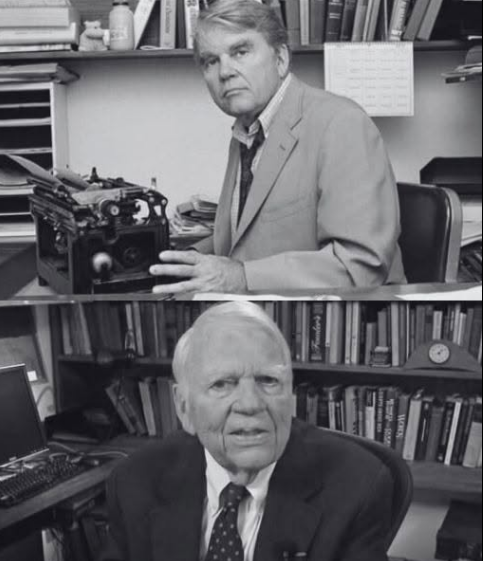
Most Americans remember Andy Rooney sitting behind a walnut desk at the end of 60 Minutes, staring into the camera with heavy eyebrows and an expression suggesting that something ordinary had disappointed him again.
Perhaps it was the confusing design of a milk carton. Maybe it was the unnecessary packaging around a household product, the price of groceries or the strange objects collecting inside his desk drawer.
Whatever the subject, Rooney could transform a small irritation into several minutes of sharp, funny and surprisingly thoughtful television.
His commentaries appeared casual, but the man delivering them had spent decades learning how to observe people and write with precision. Long before Rooney became television’s best-known curmudgeon, he had witnessed aerial combat, entered a liberated concentration camp and reported from the ruins of Europe during World War II.
Those experiences shaped his understanding of journalism, human behavior and war. They also helped create the stubborn writer who was willing to leave CBS when the network refused to broadcast one of his most personal essays.
A Young Writer Goes to War
Andrew Aitken Rooney was born in Albany, New York, on January 14, 1919. He attended Colgate University, where he became involved with the student newspaper and developed his interest in writing.
His education was interrupted by World War II.
Rooney was drafted into the United States Army in 1941. He soon joined Stars and Stripes, the newspaper written for American service members, and began reporting from Europe.
The assignment placed him close to some of the war’s most dangerous and historically significant events. In February 1943, Rooney was among a small group of American correspondents who accompanied a bombing mission over Germany.
His report, “How It Feels to Bomb Germany,” described the experience from inside a military aircraft. He wrote about the crews, the formation of the planes and the sight of bombs falling toward their targets.
It was not an abstract discussion conducted safely from a newsroom. Rooney had watched the machinery of war operating around him.
As the conflict continued, he followed Allied forces through Europe. He reported on the liberation of Paris and reached the Ludendorff Bridge at Remagen shortly after American troops captured it in March 1945. Seizing the bridge gave the Allies an important route across the Rhine and became one of the most dramatic stories of the final months of the war.
Rooney was also among the American journalists who entered the Buchenwald concentration camp after its liberation.
What he encountered there permanently affected him. Rooney had initially opposed American involvement in the war, but the evidence of Nazi atrocities forced him to reconsider whether some wars might be necessary.
He did not emerge from Europe romanticizing combat. He understood that war could sometimes be justified while remaining brutal, destructive and filled with suffering.
That tension stayed with him for the rest of his life.
Building a Career Behind the Camera
After the war, Rooney turned his attention to broadcasting.
He joined CBS in 1949 and wrote for Arthur Godfrey, one of the most influential personalities in American radio and early television. He later worked on The Garry Moore Show and became increasingly involved in documentaries and public-affairs programming.
Although audiences would eventually recognize Rooney instantly, he spent much of his early career behind the camera. He considered himself a writer first.
During the 1960s, Rooney formed a successful creative partnership with CBS correspondent Harry Reasoner. Rooney wrote and produced while Reasoner delivered the narration.
Together, they created television essays about subjects that might have appeared too ordinary for serious broadcasting. Their programs included An Essay on Doors, An Essay on Bridges, An Essay on Hotels and The Strange Case of the English Language.
These were early examples of the approach Rooney would later perfect on 60 Minutes. He looked closely at familiar objects and customs, asked why people accepted them without question and found humor in the gap between how life was supposed to work and how it actually worked.
Rooney could be skeptical without sounding completely detached. His complaints were often funny because viewers had experienced the same annoyances.
He also worked on more serious productions. In 1968, he wrote for the CBS documentary series Of Black America. One of its programs, Black History: Lost, Stolen, or Strayed, examined how Black history had been ignored or distorted in American education and popular culture.
The documentary earned Rooney his first Emmy Award.
The Essay CBS Would Not Broadcast
Rooney’s most significant disagreement with CBS occurred around 1970.
He had written a personal television program called An Essay on War. Drawing upon his experiences during World War II, Rooney examined the language, memory and reality of armed conflict.
CBS declined to broadcast it.
For Rooney, the decision was not merely a disagreement over scheduling or editing. The essay involved a subject he had experienced directly and thought deeply about for decades. He was unwilling to abandon it simply because the network had rejected it.
Rooney left CBS and took the program elsewhere.
The essay was eventually shown on public television, with Rooney delivering it himself on camera. That appearance was important for another reason: audiences were no longer hearing his ideas through a correspondent such as Harry Reasoner. They were seeing the writer present his own words.
The broadcast helped establish Rooney as an on-screen personality and earned him a Writers Guild Award.
His departure from CBS was not permanent. Rooney returned to the network in 1973 and resumed writing and producing television specials. His later programs included In Praise of New York City, Mr. Rooney Goes to Washington, Mr. Rooney Goes to Dinner and Mr. Rooney Goes to Work.
The episode nevertheless revealed an important part of his character. Rooney believed that a writer’s words mattered enough to defend, even when doing so created professional uncertainty.
Finding His Place on 60 Minutes
Rooney made his first appearance in what became his familiar 60 Minutes role in July 1978. His commentary examined the way news organizations reported automobile deaths during holiday weekends.
The segment soon became a regular feature.
By the fall of 1979, “A Few Minutes with Andy Rooney” had secured its place at the end of the broadcast. Rooney remained there for more than three decades.
His style was immediately recognizable. He sat at a desk he had made himself and spoke directly to viewers. There were no elaborate graphics, dramatic interviews or complicated visual effects. The segment depended on Rooney’s writing, delivery and ability to notice details other people overlooked.
He wondered why manufacturers made packages so difficult to open. He examined the clutter in his office. He complained about language, advertisements, holiday traditions, telephone calls and hundreds of other features of ordinary American life.
The subjects could seem trivial, especially after 60 Minutes had spent the previous hour investigating political corruption, international conflict or corporate wrongdoing. Yet Rooney’s segment worked because it brought the program back into the viewer’s home.
He talked about the objects sitting in people’s kitchens, garages and junk drawers. He made television feel personal.
Rooney’s humor was rarely built around conventional jokes. It came from observation, repetition and his ability to follow a simple question toward an unexpected conclusion. His irritation became a form of curiosity.
Why was an object designed that way? Why did people use a certain expression? Why did everyone follow a custom that made little sense?
Even when viewers disagreed with his conclusions, they understood the questions.
A Voice That Could Create Controversy
Rooney’s bluntness was not always harmless or charming.
Over the years, some of his comments offended viewers and led to public criticism. In 1990, CBS suspended him following controversy over remarks widely regarded as offensive. He later returned to the program.
In 1994, Rooney faced another backlash after commenting dismissively on the suicide of Nirvana singer Kurt Cobain. He apologized during the following week’s broadcast and acknowledged that he had failed to understand the role of depression.
These incidents are important to his full story. Rooney’s willingness to speak freely could make his work memorable, but confidence did not automatically make every opinion wise or fair.
His career demonstrated both the value and the danger of personal commentary. An independent voice can challenge comfortable assumptions, but it must also be prepared for scrutiny and correction.
Rooney did not always get the balance right.
Nevertheless, his directness helped distinguish him during an era when television journalism was often highly polished and carefully formal. He sounded less like a broadcaster delivering an approved statement and more like a neighbor who had been thinking about something all afternoon.
A Writer Until the End
Rooney ultimately produced more than 1,000 essays for 60 Minutes. He received multiple Emmy Awards, including a lifetime achievement honor in 2003, and published numerous collections of his writing.
Despite his television fame, he continued to describe himself primarily as a writer.
That identity explains the apparent simplicity of his broadcasts. Rooney understood that strong commentary did not always require a grand subject. A writer could begin with a paperclip, a cereal box or a phrase people used incorrectly and uncover something revealing about modern life.
His final regular appearance on 60 Minutes aired on October 2, 2011. Rooney was 92.
He resisted describing the occasion as retirement and made it clear that he had never enjoyed being treated as a celebrity. He wanted his work to receive attention, but he valued the private identity of the person who created it.
Andy Rooney died on November 4, 2011, after complications following surgery.
The Lasting Appeal of Andy Rooney
Rooney’s career connected two very different forms of journalism.
As a young correspondent, he reported from bombers, battlefields and devastated European cities. Later, he became famous for examining the smallest details of peaceful domestic life.
The distance between those roles may not be as great as it first appears.
Both required careful observation. Both depended on noticing what other people ignored. And both reflected Rooney’s belief that clear writing could make an audience look again at something it thought it already understood.
His legacy is more complicated than the image of a lovable television grouch. He was a decorated war correspondent, documentary writer, producer, essayist and occasionally controversial commentator. He could be insightful, stubborn, funny and wrong—sometimes within the same short segment.
What made him distinctive was his determination to sound like himself.
Television changed dramatically during his career, becoming faster, louder and more dependent on spectacle. Rooney continued sitting at his handmade desk with a few ordinary objects and several carefully arranged paragraphs.
Then he looked into the camera and asked a question.
For a few minutes, millions of people stopped to consider the answer.
Leave a Reply