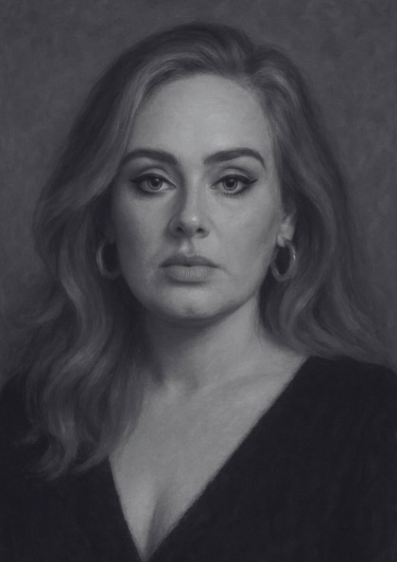
Before millions of people sang her lyrics, before her albums broke sales records, and before she performed in some of the world’s largest venues, Adele Laurie Blue Adkins was a girl growing up in a single-parent household in London.
Her journey was not shaped by instant success. It was marked by an absent father, financial limitations, painful relationships, intense public scrutiny and a frightening health crisis that threatened the very voice on which she had built her career.
Instead of hiding those experiences, Adele transformed many of them into music. Her willingness to sing honestly about heartbreak, regret, loneliness and healing eventually helped listeners around the world recognize their own emotions in her songs.
Raised by a Young Single Mother
Adele was born on May 5, 1988, in Tottenham, North London. Her mother, Penny Adkins, was only 18 when she gave birth to her.
Adele’s Welsh father, Marc Evans, left the family when Adele was still very young. Although she had some contact with him afterward, their relationship became increasingly strained. Her mother consequently carried most of the responsibility for raising her.
Penny took different jobs and made sacrifices to support her daughter. The family did not enjoy the security or privileges that often surround future celebrities. They moved several times, living in places that included Brighton, Brixton and West Norwood.
Adele has repeatedly spoken with affection and gratitude about her mother. The closeness they developed during those uncertain years became one of the strongest relationships in her life.
The absence of her father, however, left an emotional wound.
As Adele grew older, she began to understand how deeply that relationship had affected her feelings about love, abandonment and security. Those emotions would later appear throughout her songwriting, even when individual songs were inspired by different people or situations.
Music became a place where complicated feelings could be expressed without being neatly resolved.
Discovering the Power of Her Voice
Adele began singing when she was a child and developed an early fascination with powerful voices. Artists such as Ella Fitzgerald, Etta James, Roberta Flack and the Spice Girls helped shape her musical imagination.
She did not grow up believing that she had to look or behave like a conventional pop star. What interested her was the emotional power of a performance—the moment when a singer made an audience feel something genuine.
As a teenager, Adele attended the BRIT School for Performing Arts and Technology in Croydon. The school has educated several successful British performers, but Adele entered it as an aspiring musician whose future was far from guaranteed.
She graduated in 2006. Around that time, a friend uploaded some of her demo recordings to Myspace. The songs attracted the attention of XL Recordings, and Adele was invited to meet with the label.
At first, she reportedly wondered whether the message was genuine. Soon, however, the opportunity became real.
Her debut single, “Hometown Glory,” drew inspiration from London and demonstrated the quality that would define her career: Adele did not need elaborate production to command attention. Her voice, supported by direct and emotionally observant writing, was enough.
Turning Heartbreak Into 19
Adele released her debut album, 19, in 2008. Like her later albums, its title represented her age during the period in which much of the material was written.
The album introduced listeners to a singer who sounded remarkably self-assured while writing about uncertainty, desire and emotional disappointment. Songs such as “Chasing Pavements” helped her reach audiences beyond Britain.
Her success grew quickly. In 2009, she received Grammy Awards for Best New Artist and Best Female Pop Vocal Performance.
Yet her appearance often received almost as much attention as her music.
Adele entered an industry known for imposing narrow beauty standards on women. As her profile grew, strangers publicly analyzed her body, clothing and weight. Some coverage treated her appearance as if it were more important than her talent.
Adele refused to let that conversation define her career.
She did not build her identity around satisfying every critic’s expectations. Her work centered on singing and storytelling, not presenting an artificial image of perfection. That authenticity became one of the reasons listeners trusted her.
She sounded like someone who had experienced the emotions she described.
The Album That Changed Everything
If 19 introduced Adele, her second album, 21, transformed her into an international phenomenon.
Released in 2011, the album emerged from the end of a relationship. Adele used the pain of that breakup to write songs about anger, longing, acceptance and the difficulty of watching another person move forward.
“Rolling in the Deep,” “Someone Like You” and “Set Fire to the Rain” became enormous hits. These songs did not rely on emotional distance. Adele allowed listeners to hear frustration, grief and vulnerability in her voice.
“Someone Like You” was particularly striking because of its simplicity. With little more than a piano supporting her, Adele sang about learning that a former partner had created a new life. The song expressed both the desire to let go and the painful inability to do so completely.
That emotional contradiction felt familiar to millions of people.
21 became one of the best-selling albums of the century and earned Adele six Grammy Awards in a single night in 2012. Her heartbreak had become art, and that art connected across countries, languages and generations.
But while her career was reaching extraordinary heights, her health was deteriorating.
The Terrifying Possibility of Losing Her Voice
During the success of 21, Adele developed serious problems with her voice. In 2011, she suffered a vocal-cord hemorrhage and had to cancel performances.
For any singer, vocal damage is frightening. For Adele, whose career depended so heavily on the distinctive character and emotional force of her voice, the situation threatened everything she had worked to build.
She underwent microsurgery at Massachusetts General Hospital. The procedure was followed by a demanding recovery that included a period of complete silence and gradual vocal rehabilitation.
There was no guarantee that returning to the stage would feel exactly the same.
Adele followed the medical advice, allowed herself time to heal and eventually performed again. Her comeback at the 2012 Grammy Awards was more than another appearance by a successful artist. It represented her return from a crisis that could have permanently changed her career.
The experience also forced her to take greater care of her voice and reconsider the physical demands of touring.
Her recovery demonstrated a form of strength that is sometimes overlooked: the strength to stop, accept help and give the body time to repair itself.
Motherhood and a New Sense of Purpose
In 2012, Adele became a mother when her son, Angelo, was born.
Motherhood changed the way she understood her life and success. Fame and awards were still meaningful, but they were no longer the center of her identity. She has described becoming a parent as giving her a deeper sense of purpose.
After taking time away from the spotlight, Adele returned with 25 in 2015. Its opening single, “Hello,” became a worldwide hit and proved that the public’s connection to her had not weakened.
The album looked beyond one romantic breakup. It explored nostalgia, adulthood, motherhood and the realization that time cannot be reversed. Adele was no longer simply singing to a former partner. In some songs, she appeared to be reaching toward earlier versions of herself.
The tour supporting 25 filled arenas and stadiums. The girl raised by a young single mother was now standing before tens of thousands of people, many of whom knew every word she sang.
Still, success could not protect her from further emotional upheaval.
Divorce, Anxiety and Therapy
Adele married Simon Konecki, Angelo’s father, but the relationship eventually ended. She filed for divorce in 2019.
The separation brought guilt, anxiety and difficult questions about how the change would affect their son. Adele later explained that she wanted Angelo to understand why she had made certain decisions and why she believed she needed to pursue a more honest life.
During this period, she experienced intense anxiety and began therapy. Exercise also became an important tool for managing her mental health.
The public paid enormous attention to changes in Adele’s body, but she emphasized that her motivation was not simply to become thinner. Working out helped her feel stronger and provided relief from anxiety. The transformation that mattered most to her was happening internally.
Therapy also helped Adele examine childhood pain, her relationship with her father and the patterns she carried into adulthood.
Before her father died in 2021, Adele was able to reconcile with him to some extent. She played him her album 30, including songs that reflected emotional experiences connected to her childhood and relationships.
The reconciliation could not return the lost years, but it offered a measure of peace.
Creating 30 From a Painful Transition
Released in 2021, 30 documented one of the most difficult transitions of Adele’s adult life.
The album was not simply an attack on an ex-partner or a conventional collection of breakup songs. It examined responsibility, motherhood, loneliness, anxiety and the consequences of choosing a new direction.
Adele included recordings of conversations with Angelo in “My Little Love,” allowing listeners to hear a mother trying to explain emotions that even adults struggle to understand.
Songs such as “Easy on Me” asked for compassion without avoiding accountability. Adele acknowledged that decisions can hurt other people even when those decisions are necessary for personal survival.
That complexity is central to her appeal.
Her music rarely pretends that healing happens in one dramatic moment. People can feel relief and grief at the same time. They can know that a relationship must end while still mourning it. They can forgive someone without erasing the harm that person caused.
More Than a Story About Fame
Adele’s life is sometimes presented as a simple tale of a struggling girl who became rich and famous. But the deeper lesson is not that success removes pain.
It does not.
Awards could not repair her relationship with her father. Record sales could not protect her voice from injury. Stadium audiences could not prevent anxiety, divorce or self-doubt.
What Adele repeatedly did was find a way to work through those experiences. She used music, motherhood, professional help, physical training and honest self-examination to keep moving.
She also showed that vulnerability and strength are not opposites.
Singing about heartbreak did not make her weak. Seeking therapy did not mean she had failed. Canceling performances to protect her voice was not surrender. Each decision was part of learning how to survive without pretending that nothing hurt.
Adele’s story resonates because she does not present herself as someone who conquered pain forever. She presents emotions as experiences that must be faced, expressed and gradually understood.
The child who once lived with abandonment grew into an artist capable of filling stadiums. Yet the most meaningful part of her journey may not be the size of those crowds.
It is what she chose to sing when everyone was listening.
She sang about rejection without allowing it to become her identity. She sang about heartbreak without giving up on love. She confronted anxiety without hiding behind fame. And she turned private wounds into songs that helped millions of people feel less alone.
Adele’s life reminds us that being broken is not the end of a person’s story. Healing may arrive slowly, through difficult conversations, unexpected setbacks and small acts of courage.
Sometimes we rebuild one decision at a time.
And sometimes we rebuild one note at a time.
Leave a Reply